

- 1Pourquoi les acheteurs en gros sont généralement exonérés : l'idée de la revente
- 2Le mensonge : « Ils ont dit qu'ils étaient exonérés »
- 3Hygiène des certificats : collecter, stocker, suivre, renouveler
- 4Comptabilité des ventes exonérées de TVA : à quoi devraient ressembler les commandes exonérées dans votre grand livre
- 5Le signalement de la plateforme concerne la collecte, pas la conformité
- 6L'audit : un magasin qui a taxé à zéro par confiance
- 7Où s'intègre la configuration de votre synchronisation
La partie dangereuse d'une vente exonérée de TVA n'est pas la taxe manquante — c'est le papier manquant. Taxer une commande à zéro prend un clic ; défendre ce clic nécessite un certificat que vous avez collecté au préalable.
L'e-mail arrive avec une belle commande importante jointe : « Nous sommes un revendeur, nous sommes donc exonérés de TVA — veuillez supprimer la taxe de vente de nos commandes. » Vous ouvrez le profil du client, trouvez la case à cocher d'exonération de TVA, la cochez et expédiez. Tout le monde passe à autre chose.
Si vous vendez en gros, vous avez probablement fait une version de cela — pour un compte ou vingt. La question inconfortable est celle que personne n'a posée à l'époque : où se trouve le document prouvant que l'acheteur avait le droit d'acheter hors taxe ? Si votre réponse honnête est « un e-mail où ils l'ont dit » — ou simplement « ils semblaient légitimes » — vous portez une responsabilité que vos livres ne montrent pas.
Cet article traite de cette lacune. Pas des règles fiscales d'État par État — celles-ci varient selon la juridiction, et cette conversation appartient à votre professionnel des impôts. Ce que nous pouvons couvrir, c'est la partie qui est la même partout : pourquoi les acheteurs en gros sont généralement exonérés, le devoir opérationnel qui accompagne la taxation à zéro de quiconque, et à quoi devrait ressembler la comptabilité des ventes exonérées de TVA afin qu'une commande exonérée dans votre grand livre soit une décision documentée au lieu d'une décision pleine d'espoir.
Pourquoi les acheteurs en gros sont généralement exonérés : l'idée de la revente
La taxe de vente est conçue pour être collectée une seule fois, lors de la vente au détail finale — le moment où les marchandises parviennent à la personne qui va réellement les utiliser.
Un acheteur en gros n'est pas cette personne. Lorsqu'une boutique commande 200 de vos bougies, elle ne consomme pas de bougies ; elle constitue un stock à revendre. Les taxer, puis leur faire taxer leurs clients de détail, taxerait les mêmes marchandises deux fois. Le système exonère donc le milieu de la chaîne : le revendeur achète hors taxe, et la taxe est collectée lorsque les marchandises sont finalement vendues au détail.
C'est le concept derrière l'exonération pour revente, et c'est pourquoi « en gros » et « exonéré de TVA » vont si souvent de pair. D'autres types d'exonérations existent — certaines organisations sont qualifiées pour des raisons différentes — mais pour un magasin ajoutant des ventes B2B, la revente est celle que vous rencontrerez constamment.
Voici la partie qui compte pour vos livres : l'exonération doit être prouvée. Un acheteur qui est un revendeur authentique n'est pas ce qui vous protège. Ce qui vous protège, c'est un certificat de revente ou d'exonération valide — le document dans lequel l'acheteur certifie, sous sa propre responsabilité et sur sa propre immatriculation, que l'achat est éligible. Quel certificat, délivré où, couvrant quoi : ces spécificités varient selon la juridiction, alors confirmez les exigences pour votre situation avec votre conseiller fiscal. La règle opérationnelle ne varie pas du tout.
Le mensonge : « Ils ont dit qu'ils étaient exonérés »
Le mensonge avec lequel presque tous les vendeurs en gros commencent est confortable et semble raisonnable : "c'est une vraie entreprise — ils nous ont dit qu'ils étaient exonérés, et c'est leur responsabilité, pas la nôtre."
Cela échoue sur un fait structurel : lorsque vous vendez sans facturer de taxe, vous êtes celui qui n'a pas collecté. Le certificat est ce qui transfère la responsabilité à l'acheteur — avec un certificat valide en dossier, pris de bonne foi, la réclamation de l'acheteur est le problème de l'acheteur. Sans certificat, un auditeur est généralement autorisé à considérer la vente comme imposable, et l'évaluation vous incombe : la taxe non collectée, plus les pénalités et les intérêts, pour chaque vente exonérée non documentée dans la période d'audit. Votre acheteur n'a aucune obligation de vous rembourser des années plus tard, et certains d'entre eux n'existeront plus.
Ainsi, le devoir opérationnel est clair, et c'est toute la discipline en une phrase : collectez un certificat valide avant de taxer qui que ce soit à zéro, et conservez-le aussi longtemps que votre conseiller fiscal vous le dit. Une exonération que vous ne pouvez pas documenter n'est pas une exonération. C'est une facture fiscale impayée à votre nom.
Rien de tout cela ne fait de l'acheteur votre adversaire. Les revendeurs légitimes portent ces certificats couramment et s'attendent à ce qu'on leur demande. Ceux qui deviennent silencieux lorsque vous demandez vous disent quelque chose d'utile.
Hygiène des certificats : collecter, stocker, suivre, renouveler
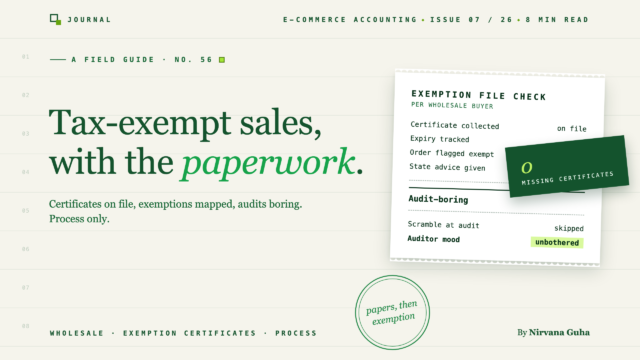
Traitez les certificats comme les documents financiers qu'ils sont, pas comme des documents d'intégration à classer et à oublier. Quatre habitudes suffisent :
- Collectez avant la première commande à taxe zéro. Faites du certificat une étape dans votre intégration en gros — demande approuvée, certificat reçu et examiné, puis le drapeau d'exonération est défini. Vérifiez-le à la réception : complet, signé, nom de l'entreprise correspondant au compte, numéro d'immatriculation présent. Un formulaire avec des champs vides ne protège personne.
- Stockez-le là où vivent les données de commande. Un certificat que vous ne pouvez pas produire pourrait aussi bien ne pas exister. Conservez une copie numérique attachée au dossier du client (ou liée à celui-ci), de sorte que toute vente exonérée soit tracée jusqu'à son document en quelques minutes — et non dans un dossier sur l'ordinateur portable de quelqu'un qui est parti.
- Suivez les expirations. Certains certificats sont illimités ; d'autres expirent ou nécessitent un renouvellement périodique — ce qui est quoi dépend de la juridiction, une question pour votre conseiller fiscal. Votre travail est la moitié opérationnelle : enregistrez une date de révision pour chaque certificat et mettez les renouvellements sur un calendrier. Un certificat expiré il y a dix-huit mois transforme silencieusement chaque commande depuis lors en une vente exonérée non documentée.
- Précisez où chaque certificat s'applique. Un certificat n'est pas un laissez-passer universel — sa validité peut dépendre de l'endroit où l'acheteur est enregistré et de l'endroit où la vente a lieu, et si vous expédiez en gros dans plusieurs États, le certificat couvrant une relation peut ne pas s'étendre à une autre. Demandez à votre conseiller fiscal où les vôtres s'appliquent et où ils n'atteignent pas, et collectez en conséquence.
Le schéma derrière les quatre : la première démarche d'un auditeur sur les ventes exonérées est de les échantillonner et de demander le certificat derrière chacune d'elles. L'hygiène signifie que cette demande est ennuyeuse.
Comptabilité des ventes exonérées de TVA : à quoi devraient ressembler les commandes exonérées dans votre grand livre
Maintenant, les livres eux-mêmes — car il y a une différence entre une commande qui a été correctement exonérée et une commande où la taxe n'est tout simplement pas là, et votre grand livre devrait être capable de les distinguer.
Une ligne de taxe zéro n'est pas la même chose qu'une configuration de taxe manquante. Une vente exonérée correctement enregistrée est postée avec sa taxe explicitement à zéro — la commande a traversé votre logique fiscale et l'exonération a été appliquée. Une commande sans aucun traitement fiscal ressemble à l'identique sur une facture et signifie quelque chose de complètement différent : personne n'a rien décidé. Si vos livres ne peuvent pas distinguer « exonéré par décision documentée » de « non taxé par accident », personne qui les examine ne le pourra non plus. La forme générale de sortie de la taxe de vente des revenus et dans un compte de passif est couverte dans notre guide de comptabilité e-commerce ; les ventes exonérées sont une branche de ce routage, pas une excuse pour l'éviter.
Séparez les revenus exonérés des revenus taxés. Gardez les ventes en gros exonérées visibles comme leur propre part — un compte de revenus distinct, une classe, ou au minimum une convention de marquage qui rapporte les « ventes taxées » et les « ventes exonérées » comme des chiffres distincts par période. Deux raisons. Premièrement, les déclarations de taxe de vente demandent couramment les ventes brutes et les ventes exonérées ou déduites, pas seulement la taxe collectée — si votre grand livre ne peut pas produire la division, quelqu'un le reconstruit à partir des exportations de commandes à chaque période de déclaration. Deuxièmement, c'est votre système d'alerte précoce : si les revenus exonérés représentent 40 % des ventes mais que vos certificats ne couvrent que des comptes d'une valeur de 25 %, cet écart est visible avant qu'un auditeur ne le trouve.
Un bref exemple fictif. Mars se termine à 80 000 $ de ventes : 62 000 $ au détail (taxées, la taxe collectée se trouvant dans un compte de passif) et 18 000 $ en gros à quatre comptes exonérés. Des livres propres montrent les 18 000 $ comme revenus exonérés, chaque compte traçable à un certificat en fichier, et un passif fiscal qui se réconcilie avec les 62 000 $ taxés — trois chiffres qui se corroborent mutuellement. Des livres qui montrent simplement 80 000 $ de revenus avec une certaine taxe collectée ne montrent rien du tout.
Si ces commandes en gros sont également à des conditions nettes de 30 jours — et la plupart le sont — la structure de facture et de comptes clients dans notre guide de comptabilité des conditions nettes est l'autre moitié de leur enregistrement correct. Et cette division est exactement ce qu'un comptable préférerait trouver en octobre plutôt que de reconstruire en janvier — c'est un problème récurrent de décembre dans notre guide de préparation de la saison fiscale.
Le signalement de la plateforme concerne la collecte, pas la conformité
Les deux plateformes principales vous offrent un interrupteur pour cela. Shopify vous permet de marquer un client comme exonéré de taxe dans son profil, de sorte que la caisse cesse de calculer la taxe sur ses commandes. WooCommerce fait l'équivalent via les paramètres de taxe client, et les plugins de vente en gros — Wholesale Suite entre autres — intègrent la gestion des exonérations dans le rôle de vente en gros lui-même, de sorte que les clients B2B approuvés tarifient et taxent différemment des acheteurs au détail automatiquement. Il convient d'être précis sur ce que cet interrupteur vous apporte, car c'est la distinction sur laquelle repose toute cette section : le rôle de vente en gros décide si la taxe est calculée, et non si l'exonération est défendable. La propre présentation de Wholesale Suite pour exonérer de taxe un client en gros trace la ligne au même endroit — le drapeau est la moitié facile, le certificat déposé est la moitié qui survit à un audit.
Utilisez ces indicateurs ; c'est le bon mécanisme. Soyez simplement clair sur ce qu'ils sont : l'indicateur contrôle si la taxe est facturée. Il ne sait rien du fait que vous soyez en droit de ne pas la facturer — aucune case à cocher ne demande un certificat, ne vérifie une date d'expiration, ou ne dépose quoi que ce soit en votre nom. Réglez l'indicateur lorsque le certificat est en main, et désactivez-le lorsqu'un certificat expire et n'est pas renouvelé. Un indicateur d'exonération de taxe sans document derrière est le mensonge mentionné précédemment, automatisé et à grande échelle.
L'audit : un magasin qui a taxé à zéro par confiance
Un magasin fictif, avec des chiffres ronds, pour rendre l'exposition concrète.
Harbor Trade Goods a ajouté la vente en gros dès la première année et cela a fonctionné : quatorze comptes B2B en deux ans, chacun passé en exonération de taxe au moment où ils ont mentionné être revendeurs. Deux ont envoyé des certificats de leur propre chef ; les douze autres ont été "gérés" par des fils d'e-mails et de bonnes intentions. La vente en gros a atteint environ 150 000 $ par an, le tout sans taxe, le tout comptabilisé dans le même compte de revenus que tout le reste.
Puis une vérification de routine de la taxe de vente. L'auditeur a extrait les ventes exonérées — faciles à repérer, ce sont les commandes sans taxe — en a échantillonné, et a demandé le certificat derrière chacune. Harbor en a produit deux. Pour le reste, l'auditeur a fait exactement ce que les règles permettent : il a traité les ventes exonérées non documentées comme imposables. À environ 8 % sur près de 250 000 $ de ventes en gros non documentées sur la période d'audit, l'évaluation s'est élevée à environ 20 000 $ de taxes — avant pénalités et intérêts. Harbor s'est précipité pour collecter les certificats rétroactivement ; certains acheteurs ont coopéré, deux avaient cessé leurs activités, et la question de savoir si les certificats collectés tardivement seraient acceptés ou non était une négociation, pas un droit. (Certaines juridictions autorisent une période de correction après le début d'un audit ; d'autres non. Ne comptez jamais dessus — et oui, vérifiez auprès de votre professionnel des impôts, car cela varie réellement.)
La taxe que Harbor a dû payer n'a jamais été la taxe de Harbor. Leurs acheteurs étaient de vrais revendeurs ; les exonérations étaient presque certainement légitimes. Ce que Harbor a payé, c'est l'absence de douze morceaux de papier — un échec de processus pur, à plus de 1 500 $ par document manquant.
Où s'intègre la configuration de votre synchronisation
Une dernière couche mécanique, car les commandes exonérées n'ont pas seulement besoin d'être approuvées correctement — elles doivent être comptabilisées correctement, à chaque fois, à côté des commandes au détail taxées qui circulent dans le même magasin.
Si vos commandes sont synchronisées automatiquement depuis Shopify ou WooCommerce vers QuickBooks, vérifiez comment la synchronisation traite la taxe et si les commandes de gros peuvent être enregistrées différemment des commandes de détail. Dans LedgerPort — notre produit, donc pesez en conséquence — la gestion des taxes se trouve dans la configuration de synchronisation : la taxe collectée est enregistrée comme une ligne distincte sur un compte de passif que vous désignez, et une commande portant un traitement fiscal sans configuration correspondante génère des erreurs et des mises en attente plutôt que d'être enregistrée sur une supposition. Une commande exonérée est enregistrée avec sa taxe explicitement à zéro — une décision enregistrée, pas une absence. Le routage basé sur les étiquettes à partir des méthodes de synchronisation des commandes peut alors maintenir les commandes de gros enregistrées comme des factures tandis que les commandes de détail continuent comme avant — le même routage qui gère le problème des conditions nettes gère celui-ci.
Quel que soit l'outil que vous utilisez, la norme est la même : les revenus taxés et exonérés sont distinguables, la taxe est dans un compte de passif, rien n'est enregistré sur une supposition.
Douze documents manquants ont coûté à la société fictive Harbor Trade Goods environ 20 000 $ — pour des taxes qu'ils n'auraient jamais dû payer. La défense n'a jamais été compliquée : certificat avant la case à cocher, stocké là où vous pouvez le trouver, suivi pour qu'il n'expire pas, et des livres qui montrent les revenus exonérés comme un chiffre honnête. Les règles derrière la paperasse appartiennent à votre professionnel des impôts. La paperasse elle-même vous appartient, et elle est peu coûteuse jusqu'à ce qu'elle soit manquante.
Si vos commandes de gros arrivent de toute façon dans QuickBooks, faites-les atterrir avec le traitement fiscal qu'elles ont réellement : voyez comment la gestion des taxes au niveau de la synchronisation enregistre correctement les commandes exonérées et taxées → — ou connectez votre magasin gratuitement et donnez à votre prochaine commande exonérée une piste papier des deux côtés.