

- 1La trampa de precios que mantiene la contabilidad de comercio electrónico sin rentabilidad
- 2Tres modelos de precios para servicios de contabilidad de comercio electrónico
- 3Modelo 1: Por horas — el predeterminado que te limita dos veces
- 4Modelo 2: Tarifa fija basada en el valor — fijación del resultado
- 5Modelo 3: Retenedores por niveles según el número de tiendas y el volumen — el modelo que escala
- 6Cómo la automatización cambia la economía unitaria
- 7Integrar la prima de especialista en tu posicionamiento
- 8Qué decir a los clientes cuando preguntan por qué cobras más
- 9Ya no estás fijando el precio de tu tiempo
La mayoría de las empresas que dicen que los clientes de comercio electrónico no valen la pena tienen un problema de precios, no un problema de clientes. Aquí te mostramos cómo arreglar el modelo, con los cálculos.
El encargo comenzó en 900 $ al mes. Lo sabes, porque lo presupuestaste: un cliente de Shopify que realiza alrededor de 1000 pedidos al mes, aproximadamente seis horas de trabajo de cierre a 150 $ la hora. Razonable. Justificable. Justo.
Luego llegó marzo. Un pago que no se correspondía con el depósito bancario, reembolsos registrados en el período incorrecto, una hora al teléfono con el contable a tiempo parcial del cliente. Once horas. ¿Cobras 1650 $ y asumes la incómoda llamada, o cobras lo presupuestado y te comes cinco horas? Te comiste las horas. La mayoría de las empresas lo hacen.
Haz eso tres o cuatro veces y una creencia se endurece hasta convertirse en política: los clientes de comercio electrónico no valen la pena. Pero esa creencia suele ser errónea de una manera específica y solucionable: el problema no es el cliente, es cómo fijas el precio de los servicios de contabilidad de comercio electrónico en primer lugar. La fijación de precios por horas traslada todo el coste de la variabilidad del comercio electrónico a tu lado de la mesa, y las cifras a continuación muestran que hay dos modelos que no lo hacen.
La trampa de precios que mantiene la contabilidad de comercio electrónico sin rentabilidad
La fijación de precios por horas se basa en una lógica que suena prudente: la contabilidad de comercio electrónico es demasiado variable para una tarifa fija; la fijación por horas es el único modelo que protege a la empresa.
Esa es la mentira, dicha claramente. Y vale la pena ser generoso al explicar por qué parece cierta. El trabajo de comercio electrónico es variable cuando la capa de conciliación es manual. Los pagos llegan netos de comisiones, los reembolsos y las disputas cruzan períodos, el impuesto sobre las ventas se esconde dentro de los depósitos y un cambio en la política de precios de una plataforma puede añadir una hora a cada cierre. Si tus horas oscilan genuinamente entre seis y once, fijar una tarifa fija de seis es una donación.
Pero mira lo que hace realmente la fijación de precios por horas en la práctica. Cuando las horas se disparan, o bien cobras el exceso y tensas la relación, o bien lo asumes y donas el margen. Y cuando te vuelves mejor en el trabajo — creas listas de verificación, estandarizas el plan de cuentas, te vuelves más rápido — la fijación por horas reduce tus ingresos como recompensa. Es el único modelo de precios que castiga tanto los malos meses como la mejora.
La variabilidad nunca fue la característica definitoria del cliente. Era una propiedad de hacer la conciliación a mano. Elimina la capa manual y el argumento de "demasiado variable para tarifa fija" se derrumba, que es toda la historia de por qué los clientes de comercio electrónico destruyen los márgenes de las empresas bajo el modelo predeterminado, y por qué no tienen por qué hacerlo.
Tres modelos de precios para servicios de contabilidad de comercio electrónico
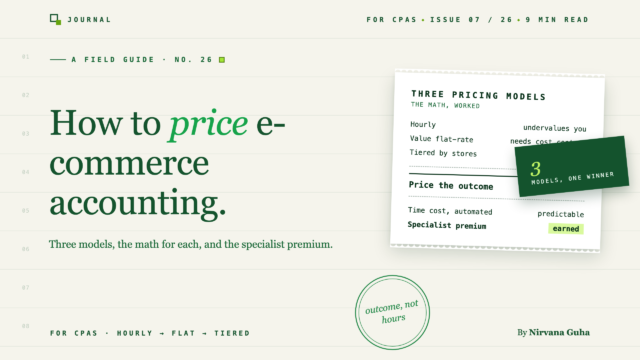
Aquí están los tres modelos que las empresas realmente usan, con las matemáticas del mismo compromiso ficticio: un cliente de Shopify de una sola tienda, alrededor de 1.000 pedidos al mes, cierre mensual más conciliación de pagos, separación de tarifas y revisión de impuestos sobre las ventas. Todos los números son ilustrativos: cifras redondas para hacer visibles los mecanismos, no puntos de referencia.
Modelo 1: Por horas — el predeterminado que te limita dos veces
Las matemáticas. Seis horas en un mes normal a 150 $/hora son 900 $. En un mes malo —un pago disputado, una acumulación de devoluciones— son diez u once horas, y ya has visto por qué ese número rara vez se factura en su totalidad.
Dónde sale mal. Promediado durante un año con dos meses malos y las amortizaciones típicas, ese compromiso de 900 $ se materializa en algo más cercano a 120-130 $ por hora. Y tu techo es tu calendario: a horas, hacer crecer el libro de comercio electrónico significa contratar en proporción a él, que es exactamente la trampa de la que la mayoría de las empresas intentan escapar.
Por horas está bien para proyectos puntuales: una limpieza, un diagnóstico. Como modelo permanente para el trabajo recurrente de comercio electrónico, infravalora tu experiencia en los meses buenos y se come tu margen en los malos.
Modelo 2: Tarifa fija basada en el valor — fijación del resultado
Cómo se ve. Un número, mensual, para un alcance definido: libros cerrados para el día 10, pagos conciliados, tarifas separadas, impuestos sobre las ventas revisados, un breve resumen mensual. Para este cliente, una tarifa fija de 1.250 $/mes es un número justo: el cliente obtiene certeza presupuestaria y el resultado de un especialista; tú te quedas con las ganancias de ser bueno en esto.
Cómo establecer el suelo. Cobra el peor mes realista, no el promedio. Si un mes malo te cuesta nueve horas, tu suelo es 9 × 150 $ = 1.350 $ — y ahí está el problema. Hecho manualmente, una tarifa fija honesta te pone por encima de lo que el mercado espera, por lo que las empresas recortan el número y vuelven silenciosamente al negocio de las amortizaciones por la puerta de atrás.
Por eso la tarifa fija tiene reputación de ser valiente. No es valiente: solo es segura cuando tus horas en el peor de los casos son bajas y predecibles. Guarda esa idea para una sección.
Cómo comunicarlo. Nunca como "seis horas de trabajo". Como el resultado: "Tus libros se cierran el día 10, conciliados hasta el último céntimo, por 1.250 $ al mes". El alcance delimita la carta de compromiso — banda de volumen de pedidos, número de tiendas, qué desencadena una nueva cotización — haz la protección que antes hacía la facturación por horas.
Modelo 3: Retenedores por niveles según el número de tiendas y el volumen — el modelo que escala
La tarifa fija responde a un cliente. Los niveles responden a una práctica. Agrupa tus contratos por las dos cosas que realmente impulsan el esfuerzo — número de tiendas y volumen de pedidos — y publica las bandas como una lista de tarifas:
| Banda | Perfil del cliente | Retenedor mensual (ilustrativo) |
|---|---|---|
| 1-5 tiendas | Marca única, hasta ~5.000 pedidos/mes combinados | 950-1.500 $ |
| 6-20 tiendas | Operador multimarca o agregador | 2.500-4.500 $ |
| 20+ tiendas | Operador a escala de cartera o agencia | Personalizado, desde 6.000 $ |
Este es el modelo de precios de retención en un párrafo: establezca el suelo de cada banda en su costo del peor mes, delimite el alcance por volumen y cobre la incorporación por separado: una tarifa fija única para la configuración, el mapeo y cualquier limpieza histórica, de modo que el primer mes complicado nunca contamine el margen recurrente. (La limpieza en sí también se puede delimitar como un proyecto fijo; el manual de limpieza de archivos explica cómo).
Los niveles hacen dos cosas silenciosas por usted. Pre-responden a "¿qué sucede cuando abro mi segunda tienda?" con un número en lugar de una renegociación. Y hacen que sus precios parezcan infraestructura, lo cual, si la siguiente sección es cierta para su empresa, lo es.
Cómo la automatización cambia la economía unitaria
Todo lo anterior depende de una variable: sus horas por cliente por mes. La automatización es cómo esa variable deja de ser variable.
Ejecute la misma retención de $1,250 de ambas maneras. Manual: seis horas a su costo de oportunidad de $150 son $900, lo que deja $350, un margen del 28% que dos meses malos pueden borrar. Automatizado, con la conciliación manejada por software: el cierre se convierte en una revisión; llamémoslo 75 minutos, alrededor de $190 de su tiempo. Las herramientas añaden unos pocos dólares más (abajo). Margen: aproximadamente $1,040, o alrededor del 83%. Mismo cliente, misma retención, misma entrega. Lo único que cambió es que el costo variable salió del compromiso.
El número de herramientas es menor de lo que la mayoría de las empresas adivinan. El plan Enterprise de LedgerPort cuesta $169/mes para pedidos ilimitados y negocios ilimitados, una suscripción que cubre toda la cartera de clientes, con cada cliente gestionado como un negocio separado bajo un único inicio de sesión de la empresa, cada uno sincronizándose con su propio archivo de QuickBooks. Con diez clientes, son aproximadamente $17 por cliente al mes; con veinticinco, menos de $7. Frente a una retención de $1,250, el costo del software se reduce a ruido.
Dos detalles del producto son especialmente importantes para la fijación de precios, porque atacan las horas del peor caso que establecen su suelo:
- La Plantilla Maestra. LedgerPort admite una Plantilla Maestra que aplica su configuración estándar de plan de cuentas a múltiples clientes; sus decisiones de mapeo de cuentas se convierten en propiedad intelectual de la empresa, aplicadas a cada nuevo cliente en lugar de reconstruidas desde cero. Eso es lo que hace que una tarjeta de tarifas publicada sea honesta: cada cliente opera en los mismos rieles, por lo que el servicio a cada cliente cuesta aproximadamente lo mismo.
- Importación histórica. La función Time Machine inserta hasta 24 meses de datos históricos de pedidos en QuickBooks, lo que convierte "los libros son un desastre incluso antes de empezar" de un riesgo ilimitado a un elemento de línea de incorporación de tarifa fija y delimitable.
También existe un Programa de Socios CPA formal basado en este modelo: facturación al por mayor a nivel de empresa (páselo a los clientes o absórbalo en la retención), además de una opción entre una participación en los ingresos de los clientes referidos o pasarles un descuento, lo que mejor se adapte a cómo opera su empresa.
Integrar la prima de especialista en tu posicionamiento
Un abogado fiscalista cobra más que un abogado generalista por la misma hora. No porque la hora sea más larga, sino porque el resultado es más escaso y se incluye el riesgo de equivocarse. La contabilidad de comercio electrónico soporta la misma prima, y la mayoría de las firmas generalistas no pueden discutirla: no saben por qué el pago de Shopify nunca equivale a las ventas menos los reembolsos, y sus clientes los han visto aprender mientras trabajaban.
Sin embargo, la prima tiene que ser creíble, y la credibilidad aquí es infraestructura. Un plan de cuentas estándar para comercio electrónico. Un proceso de incorporación de clientes documentado que va desde la carta de encargo hasta la primera conciliación sincronizada en menos de una hora. Una capa de conciliación que funciona con software en lugar del sábado de un empleado. Cuando un cliente potencial pregunta qué te diferencia de su CPA actual, "tenemos un sistema para exactamente tu tipo de negocio" es una respuesta que un generalista no puede fingir, y es lo que permite que la banda de 1 a 5 tiendas comience en $950 en lugar de $500.
Qué decir a los clientes cuando preguntan por qué cobras más
Preguntarán. Ten la respuesta lista y enfócala en su riesgo, no en tu esfuerzo:
- "No pagas por horas. Pagas por un conjunto de libros cerrado y conciliado para el día 10 de cada mes, a un precio que nunca te sorprende." La certeza es el producto. Su último contable facturaba por horas y las facturas se extraviaban.
- "Los libros de comercio electrónico fallan de maneras específicas: pagos que no coinciden con los depósitos, comisiones ocultas en transferencias netas, tarjetas de regalo registradas como ingresos. Hemos construido nuestra práctica en torno a esos modos de fallo." Lo específico vence a lo barato. Menciona los problemas exactos que ya han experimentado.
- "Un generalista cobra menos al mes y cuesta más al año." Las tareas de limpieza que llegan —ingresos contados dos veces, una cuenta de compensación que nunca se ha puesto a cero— son lo que realmente compra el descuento.
Observa lo que falta: cualquier mención de tu software, tus horas o tus costos. El cliente está comprando un resultado. La infraestructura es la razón por la que puedes prometerlo, no es el argumento de venta.
Ya no estás fijando el precio de tu tiempo
Vuelve a ese encargo de marzo. Bajo el modelo antiguo, el pago que no cuadraba te costó cinco horas no facturadas y un atisbo de resentimiento hacia un cliente perfectamente bueno. Bajo este modelo, el mismo marzo se ve así: la sincronización se ejecutó, las excepciones aparecieron en un registro, tu superior las revisó en veinte minutos y el anticipo se registró como cada mes. El cliente nunca supo que marzo fue difícil, porque para ti no lo fue.
Una vez que la infraestructura está en su lugar, no estás fijando precios para tu tiempo, estás fijando precios para el resultado. Ese es un negocio fundamentalmente más rentable.
Todo el modelo descansa en una condición: tu costo de tiempo por cliente tiene que ser predecible antes de que las tarifas fijas sean seguras para publicar. Esa predictibilidad es exactamente lo que LedgerPort fue construido para dar a las firmas de contabilidad — mira cómo las firmas gestionan libros de comercio electrónico multicliente en él →, o inicia la incorporación de CPA y ejecuta un cliente a través de él → para probar tú mismo las matemáticas del peor escenario.