

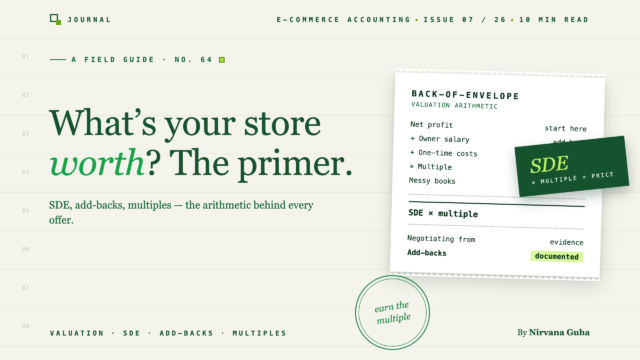
- 1How Much Is My Ecommerce Store Worth? The Real Formula
- 2SDE: The Number Your Store Is Actually Priced On
- 3The Add-Back Fight: What Counts and What Gets Struck
- 4The Multiple: A Range You Influence, Not a Number You Look Up
- 5Same Store, Two Sets of Books
- 6Why Deposit Books Shrink SDE Directly
- 7What Your Store Is Worth Is What You Can Prove
The formula is public: SDE times a multiple. The money is in how SDE gets built, which add-backs survive a buyer's accountant, and why the same store can wear two very different price tags.
The cold email lands on a Thursday: an aggregator is "actively acquiring brands in your category" and would love a call. You weren't planning to sell. But that night you find yourself typing how much is my ecommerce store worth into a search bar, and twenty minutes later you've fed your revenue into a free valuation calculator that spits back a range of $180,000 to $640,000 — a spread wide enough to be an insult.
So you ask in a founder group. One person says stores like yours go for 2.5 times profit. Another swears their friend got 4. A third quotes a revenue multiple that would make your store worth more than the aggregator's fund. Everyone is confident. Nobody agrees.
Here's the reframe this post is built on: you've been hunting for the wrong number. The multiple is the output of a valuation, not the input — and you don't control it directly. What you control is the number the multiple gets applied to. That number has a name, precise rules, and a bad habit of shrinking when books are messy. Learn the machinery and the forum noise stops mattering.
How Much Is My Ecommerce Store Worth? The Real Formula
Nearly every small e-commerce acquisition prices off the same structure:
Price = SDE × a multiple.
SDE is seller's discretionary earnings — the annual cash the business generates for one owner-operator, reconstructed from your books. The multiple is a market number: a range drawn from what comparable stores have actually sold for recently, adjusted for how risky and transferable your store looks.
(Larger businesses — typically past seven figures of profit, with real management teams — price on EBITDA instead. The mechanics rhyme; the add-back logic below still applies.)
The lie hiding in the forum answers is that the multiple is where the game is played — that somewhere out there is the correct multiple for your store, and finding it is the whole job. It isn't. Two stores with identical revenue routinely sell for wildly different prices, and the difference is rarely that one seller negotiated a better multiple. It's that one seller walked in with a bigger, better-documented SDE — and a business whose risk profile earned the top of the range instead of the bottom.
So work the formula in the order buyers do: build SDE first, understand what moves the range second.
SDE: The Number Your Store Is Actually Priced On
SDE starts with net profit and rebuilds upward. The standard construction:
SDE = net profit + owner compensation + interest + depreciation and amortization + true one-time expenses + owner personal expenses run through the business.
The logic behind every line is the same question: what would this business earn for a new owner-operator? Your salary gets added back because the buyer replaces you and pays themselves. Interest gets added back because your loans don't transfer — the buyer brings their own capital structure. Depreciation is a non-cash entry. The site redesign you paid for once isn't a cost of running the business every year.
Notice what this means: your P&L's bottom line is not your store's earning power. A store showing $150,000 in net profit while paying the owner an $80,000 salary has an SDE north of $230,000 before any other adjustment. Sellers who quote their net profit in early conversations routinely undersell their own business by a third.
But there's a catch that decides deals, and it's the next section: every dollar you add back has to survive an argument.
The Add-Back Fight: What Counts and What Gets Struck
Add-backs are where valuations get renegotiated. You propose them; the buyer's accountant tests them; what survives becomes the SDE the price is actually computed on. Brokers will tell you more deals reprice over add-backs than over the headline multiple.
The categories sort roughly like this:
| Category | Examples | How buyers treat it |
|---|---|---|
| Standard — accepted with documentation | Owner salary and payroll taxes, owner health insurance, interest, depreciation, owner's cell phone and vehicle | Accepted when the paper trail is clean: payroll records, clearly labeled accounts |
| True one-times | A site redesign, a lawsuit settlement, a warehouse move | Accepted with invoices — if it genuinely didn't recur |
| Gray zone — expect a fight | A spouse on payroll, "one-time" marketing spend that appears every year, below-market rent from a related party | Challenged: who does that work after closing? Is that cost really gone? |
| Rejected | Undocumented cash claims, add-backs with no receipts, ad spend trimmed and relabeled "discretionary" | Struck — and each strike erodes trust in the rest of the schedule |
Two things sellers consistently miss.
First, adjustments run in both directions. If you work sixty-hour weeks and pay yourself nothing, the buyer doesn't celebrate the low payroll — they subtract the market cost of replacing you. Same if your related-party rent is half of market rate. SDE is normalized earnings, not maximized earnings.
Second, an undocumented legitimate add-back is worth zero. Your health insurance really is an owner expense — but if it's buried in COGS with no clean account behind it, you can't claim it without inviting the question of what else is buried. The dollars were real. The proof wasn't. The proof is what gets priced.
The Multiple: A Range You Influence, Not a Number You Look Up
So what is the multiple? A range, set by the market: what comparable stores — similar size, model, and channel — have sold for recently. Brokers and recent comps set that range, and it moves over time with buyer demand and credit conditions. We're deliberately not quoting one here, because any number in a blog post is stale the day it publishes and wrong for your specific store besides. When you're serious, a broker with current comps will give you a real range in one conversation.
What you should study instead is what moves a store within its range. Buyers pay at the top for stores that look durable and transferable, and at the bottom — or below — for stores that look like they might leave with the seller:
- Transferability. Can it run without you? Documented SOPs, a team or VA bench, and processes that don't live in your head all push upward. A store that is secretly a job pushes down.
- Growth trend. Two to three years of steady growth reads very differently from a spike, a plateau, or a decline — which is why buyers ask for monthly P&Ls.
- Channel and platform risk. One sales channel, one supplier, one hero SKU, or traffic that is 85% paid ads on a single network — every concentration is a discount. Diversified revenue, owned email lists, and repeat-customer depth push the other way.
- Margin quality and durability. Real, verifiable gross margins — with platform fees visible rather than smeared into revenue — plus defensible pricing power.
- Age and track record. More verified history, less perceived risk.
Notice that half of these are business decisions and half are bookkeeping visibility. A store with excellent repeat-purchase economics that can't demonstrate them cleanly gets priced as if they don't exist.
Same Store, Two Sets of Books
Here's the machinery in one worked example. Every number is fictional and round. The store is the same store, the same year, the same cash — the only variable is how the books were kept.
The underlying economics: $1.1M in gross sales, $40,000 in refunds, $406,000 true COGS, $62,000 in platform and processing fees, $70,000 owner salary, $110,000 other payroll, $14,000 owner health insurance, $15,000 one-time rebrand, $175,000 other operating costs — and $20,000 in Shopify Capital repayments withheld from payouts.
Version one: deposit books. Revenue is whatever hit the bank: $978,000 (gross sales minus refunds, fees, and the Capital withholding — all invisible). The health insurance sits inside a $420,000 COGS line. The rebrand hides in marketing. Net profit on paper: $188,000. Claimable SDE: $188,000 plus the $70,000 salary that payroll records can prove — $258,000. The insurance and rebrand add-backs are real but commingled and undocumentable, so they die in review. Worse, revenue ties to nothing Shopify reports, so even the surviving number gets read skeptically.
Version two: clean books. Gross revenue $1.1M, refunds contra-revenue, fees on their own line, owner costs and the rebrand in labeled accounts, the Capital repayment booked as debt principal — not a revenue reduction. Net profit: $208,000. SDE: $208,000 + $70,000 salary + $14,000 insurance + $15,000 one-time = $307,000, with a document behind every line.
Same store. $49,000 of SDE difference. Multiply that gap by any multiple a broker shows you and name the price difference yourself — then remember it bought no new product, no new customers, and no new revenue. It was bookkeeping.
Why Deposit Books Shrink SDE Directly
The worked example's $49,000 gap has three distinct mechanisms, and it's worth seeing each one, because one of them is pure found money.
Non-expenses netted into revenue. That $20,000 Shopify Capital withholding is loan principal — not an expense at all. Deposit books treat it as money the business never earned, understating profit dollar for dollar. Reserves and holds do the same thing on a delay.
Legitimate add-backs buried beyond proof. The $29,000 of insurance and rebrand didn't disappear — it became unclaimable. Buried dollars don't just fail as add-backs; they distort the COGS and margin numbers buyers benchmark hardest.
Fees you can't see, margins you can't defend. When platform and processing fees hide inside net deposits, grossing them up is found money at a multiple: your revenue rises, your fee line becomes a visible, benchmarkable cost, and your gross margin finally matches your Shopify reports. The mechanics of splitting them out are in our guide to handling Shopify fees in QuickBooks, and the payout-level version lives in reconciling Shopify payouts.
None of this requires selling soon. Every payout-reconciled month is one more month of provable SDE — and buyers weight recent months heaviest. This is the category of problem sync tools exist for: LedgerPort, for example, books gross sales, refunds, and fees from Shopify or WooCommerce into QuickBooks on their own lines automatically, so the version-two books in the example are the default rather than a restatement project.
What Your Store Is Worth Is What You Can Prove
You opened a calculator asking what your store is worth. The honest answer is a two-part number — SDE times a range — and the part you control is bigger than the part you Google. Build SDE in clean, labeled accounts. Claim add-backs you can document and concede the ones you can't. Push your store up its range with transferability and channel depth. Then let a broker with live comps tell you what the market is paying — that conversation is cheap, and it's accurate in a way no calculator will ever be.
And when a real buyer shows up, the exam moves from valuation to verification. That stage has its own preparation — what buyers request, where e-commerce books fail, and the cleanup runway — covered in our companion guide to due-diligence-ready books. If the whole foundation needs building first, start with the e-commerce accounting pillar.
The $49,000 in the worked example is the takeaway in one number: the same store, priced twice, because only one version could prove itself. Whether your exit is next year or a someday idea, the proof compounds from the month you start keeping it.
This post explains valuation mechanics, not valuation advice. Multiples, deal structure, and the tax treatment of a sale are conversations for your broker, CPA, and attorney — bring them in early.