

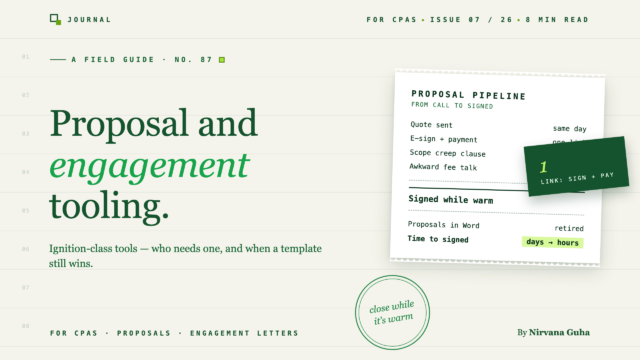
The tool doesn't sell for you. It closes the gap between "yes" and "paid, signed, and started" — which is where firms quietly lose their margin.
You're reviewing a client's file in November and you notice the engagement has grown. Two stores now, not one. Payroll questions you've been answering since June. A sales tax registration you handled in August because it was faster than explaining it wasn't included. The engagement letter says none of this — and when you go looking for the letter, you find the version you sent in January. Unsigned.
Nobody did anything wrong, exactly. The client said yes on a call, you started work because starting felt like good service, and the paperwork became a follow-up that never got followed up. This is the gap that proposal software for accounting firms exists to close — and it's worth understanding what the category actually fixes before you look at a single vendor, because it's narrower and more valuable than the name suggests.
The Three Failures Proposal Software Actually Fixes
The lie the category has to overcome is the one you may be telling yourself right now: "proposals are a Word template problem — we already have engagement letters." You do. The letter isn't the problem. The handoff is — the sequence between a client saying yes and the work actually starting, priced and papered. That handoff is a system, and when it's run manually it fails in three specific, expensive ways.
Unpriced scope creep. The November file above. When scope lives in a static document nobody re-reads, every small addition is absorbed rather than quoted, because re-papering the engagement costs more friction than doing the work. Multiply by fifteen clients and you're running a percentage of your practice for free — permanently, because unpriced work becomes expected work.
Unsigned engagement letters. Every firm that's honest with itself has active clients on unsigned letters. It's a liability problem — your professional indemnity insurer and your state board both have opinions about working without a signed engagement — but it's also a pricing problem. An unsigned letter is an unagreed price. You find out which parts the client never agreed to at the worst possible moment: when the relationship is already going sideways.
Slow starts. The proposal goes out, then silence. The client is 80% sold and 100% busy, and the deal ages in an inbox while you decide whether a nudge looks eager. Meanwhile the work you quoted against this quarter's capacity slips into next quarter's. Deals that die between verbal yes and signature aren't lost to competitors — they're lost to friction.
Notice what all three have in common: none of them is a sales problem. They're operational failures in the sales-to-work handoff. That's the honest job description of this category — it takes "yes" and mechanically converts it into a signed scope, a collected payment, and a started engagement, in one motion, with no follow-ups for anyone to drop.
The Landscape: Ignition, GoProposal, and the Anchor Class
The firm-specific end of the market has consolidated around a recognizable class: Ignition, GoProposal, and Anchor are the names you'll hear most, with generic proposal tools (the Proposify and PandaDoc class) orbiting nearby. A note before the sketches: nobody here paid to appear, there are no affiliate links, and pricing in this category changes often and tiers by client count and payment volume — verify current pricing directly with each vendor. What follows is positioning, which moves slower than price lists.
Ignition is the category anchor for accounting and bookkeeping firms: proposal, engagement letter, and payment authorization in a single client-facing flow, with recurring billing and renewal automation behind it. Its defining idea is that acceptance and payment should be the same event — the client signs and the billing starts, no separate invoice chase. It's positioned toward firms running recurring engagements at volume, which is exactly where the renewal automation earns its keep.
GoProposal, now under Sage, leads with pricing consistency. Its core is a configurable pricing engine: you encode how your firm prices — the line items, the drivers, the minimums — and every team member produces the same quote for the same scope. That's the draw for firms where partners each price by feel and the feels disagree. Engagement letters generate from the selected scope automatically, so the letter always matches what was actually sold.
Anchor is the newer entrant, built payment-first: engagement agreements wired directly to billing, with a pricing model that's historically been aggressive on cost per transaction. It's leaner than the suites — the appeal is precisely that it does the agreement-to-payment spine without the surrounding platform, which suits firms that already have proposal habits and mostly need the enforcement layer. Check current terms; lean tools add layers over time.
The generic class — Proposify, PandaDoc, and similar — does beautiful documents and e-signature for any industry. What it lacks is the accounting-firm spine: recurring billing tied to acceptance, engagement renewal cycles, integration with your ledger and practice management stack. If proposals are an occasional event in your firm, generic may be enough. If recurring engagements are your business model, the firm-specific class exists for a reason.
Four Capabilities to Demand in the Demo
Feature grids in this category all look the same. These four separate the tools that will change your firm's economics from the ones that will make your PDFs prettier.
1. Templated scope language with fences. The proposal is only as protective as the scope written into it. What you want is a library of service definitions where the boundaries are part of the template: order volume bands, store counts, what triggers a re-quote. If you've built the kind of scope fences described in how to price e-commerce accounting services — "books closed by the 10th, up to 1,000 orders a month, one store, second store triggers the next band" — the tool should hold that language and reuse it identically on every proposal. Scope creep dies in the template, not in the negotiation.
2. Payment on acceptance. The signature and the payment method should be collected in the same motion. This single mechanic kills two of the three failures at once: no more unsigned-but-active clients (work doesn't start until acceptance, and acceptance includes payment authorization), and no more first-invoice chase (the billing rail is live from day one). In the demo, ask to see exactly what the client experiences from opening the proposal to the firm getting paid. Count the steps. Every extra step is where deals will stall.
3. Renewal and price-increase automation. This is the quiet killer feature, because it automates the conversation firms avoid for years. A renewal cycle that re-proposes each engagement annually — at updated pricing — turns the awkward "we need to talk about our fees" call into a routine document the client expects. Firms carry underpriced legacy clients not because they can't do the math but because the conversation is uncomfortable; a system that raises prices on schedule removes the discomfort and the delay. Ask the vendor to walk through a bulk renewal with a percentage increase. If it's clumsy, you'll never use it, and you'll still be carrying 2024 pricing in 2028.
4. Integrations with your ledger and your PM stack. Acceptance should cascade: the signed engagement creates the client in QuickBooks, kicks off the onboarding job in your practice management tool, and starts the billing schedule — without anyone re-keying anything. A proposal tool that doesn't talk to your practice management software just moves the handoff gap one step downstream: signed, paid, and then sitting in nobody's task list. Bring your actual stack to the demo and make the vendor show the cascade end to end.
Where This Tooling Pays Off Most: Productized Firms
Here's the pattern worth noticing: proposal software compounds with productized pricing. If every engagement is bespoke, the tool saves you formatting time. If your services are productized — defined tiers, published bands, standard deliverables — the tool becomes the delivery mechanism for your entire pricing model.
E-commerce-focused firms are the clearest case. A firm running tiered retainers by store count and order volume — the rate-card model from the pricing guide — can encode each band as a proposal template. New prospect, two stores, ~3,000 orders a month? That's a band, and the band is a one-click proposal with the scope fences already written. Pricing a new client stops being an afternoon of judgment and becomes a lookup.
Cleanup work productizes just as cleanly. A fixed-fee cleanup engagement — diagnostic fee up front, per-month-of-history banding, change orders for newly discovered defects — maps directly onto proposal templates: one for the diagnostic, one for each cleanup band, with the change-order language pre-written into the scope. The client sees the same unit math you priced with, and the paper matches the method.
The compounding is the point. Productized pricing makes proposals fast; fast proposals make you quote more consistently; consistent quoting makes the rate card real instead of aspirational. Firms that bill hourly for bespoke scopes get the least from this category — not because the tools fail, but because there's nothing standard for them to systematize.
The Job It Cannot Do
Now the honesty section, because this category's marketing implies otherwise: proposal software cannot define your services. It systematizes decisions you've already made. If you haven't decided what your monthly close includes, what triggers a re-quote, or what your bands are, the tool gives you a blank template library and a configuration screen — and you'll rebuild the same ambiguity you had in Word, except now it's ambiguity with a subscription fee and an audit trail.
The failure mode is predictable: firm buys the tool, loads its existing vague letter into a template, and six months later concludes proposal software doesn't work. The sequencing was backwards. Define the services first — even roughly, even in a spreadsheet: what's included, what's excluded, what each tier costs, what moves a client between tiers. That's two partner afternoons of genuinely hard decisions. Then buy the tool, and the tool works, because it finally has something to enforce.
If you can't write your scope fences on paper, no software can hold them for you.
The November file — the unsigned letter, the absorbed scope, the two stores priced as one — wasn't a paperwork failure. It was a handoff without a system, and the fix is sequence: define the services, fence the scopes, then buy the tool that enforces both at signature. For firms building that around e-commerce clients specifically, the delivery layer underneath those scoped engagements is its own decision — our page for CPAs and firms covers how we fit into that part of the stack.