

- 1The Question You Haven't Asked
- 2The Four Hidden Costs
- 31. Your Time (The One You're Probably Underpricing)
- 42. Error Cost (The Invisible Tax)
- 53. CPA Cleanup Hours (What You're Paying for Their Frustration)
- 64. Decision Cost (The One Nobody Calculates)
- 7The Numbers, Side by Side
- 8The Decision You've Been Putting Off
Most store owners think their bookkeeping costs either nothing or whatever they pay a bookkeeper. The actual number is usually much higher — and it compounds every month.
Ask ten Shopify store owners what their bookkeeping costs them per month, and most will say one of two things. Either: "Nothing — I do it myself." Or: "About $X — I have a bookkeeper."
Both answers are wrong.
Not because those expenses don't exist, but because they're the visible line item. The real cost is four line items, and most store owners have never added them up. When you do, the math almost always points in the same direction.
The Question You Haven't Asked
Here's the actual question: what does your bookkeeping cost per month, in total — including your time, your errors, your CPA's cleanup hours, and the business decisions you made with unreliable data?
That's a harder number to arrive at, but it's the one that matters. Let's build it.
The Four Hidden Costs
1. Your Time (The One You're Probably Underpricing)
Most store owners who handle their own reconciliation spend between 4 and 8 hours a month on it — exporting payout reports from Shopify, trying to match them to what's in QuickBooks, tracing down the mismatches, and eventually either fixing them or accepting the gap and moving on.
Let's be conservative and say 5 hours.
Now: what's your time worth? If you're running a store doing $1M a year, you're roughly a $100/hour operator — that's $200,000 in annual value divided across ~2,000 working hours. The actual number is probably higher once you account for the compounding effect of growth decisions.
At $100/hr, those 5 monthly hours cost you $500 a month — $6,000 a year.
If you've hired a bookkeeper instead and they're billing 4–6 hours a month on reconciliation at $40–60/hr, that's an additional $160–$360 in labor you can add directly to the tally.
2. Error Cost (The Invisible Tax)
Manual reconciliation has errors. Not because you're careless — because the Shopify payout structure is genuinely complex. A net disbursement that includes sales, refunds, platform fees, payment processing fees, and adjustments doesn't map cleanly to any standard accounting category. When it gets entered improperly, it shows up as a categorization error.
Categorization errors affect your reported income, your cost of goods sold, and your expense allocation — which means they affect your tax liability.
A 1.5% error rate on $80,000/month in gross revenue is $1,200 in miscategorized transactions monthly. Depending on how those errors land, you could be over- or under-reporting income by several thousand dollars per year. At a 25% effective tax rate, that's a potential exposure of $300–$1,500 per year — either paid unnecessarily or owed unexpectedly when your CPA corrects it.
This is the cost that doesn't show up until it's already happened.
3. CPA Cleanup Hours (What You're Paying for Their Frustration)
If you work with an accountant or CPA, they're touching your books at least quarterly — and if your Shopify data is messy, they're spending time fixing it.
Most CPAs charge $200–$400 per hour. If they spend an extra 30 minutes per quarter cleaning up payout data that wasn't reconciled correctly, that's $400–$800 per year in billable time. If it's worse than that — if there's a full month of unreconciled data or a year-end that requires going back and fixing six months of categorization errors — that number can jump to $1,500–$3,000 in a single year.
Ask your CPA how much time they spend on your books versus a client whose data comes in clean. The difference is your cleanup cost.
4. Decision Cost (The One Nobody Calculates)
This is the hardest to quantify and the most consequential.
When your books are unreliable, you're making business decisions with unreliable data. That means pricing decisions based on margins that may be off by a few percent. Inventory decisions based on profitability numbers that aren't quite right. Growth decisions — hiring, advertising spend, new product launches — made against a financial picture that doesn't fully reflect reality.
A single bad inventory decision at a store doing $1M a year can cost $10,000–$50,000. A pricing strategy built on incorrect margin data can erode profitability for months before it shows up in your bank account.
We won't assign a hard dollar amount to this line item. But it belongs in the model.
The Numbers, Side by Side
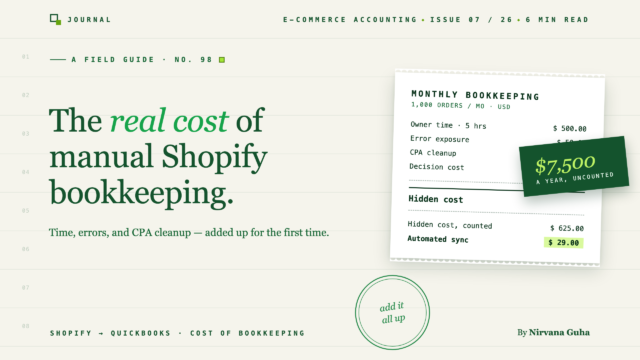
Here's what the fully loaded cost of manual bookkeeping looks like at two order volumes:
| Cost category | 1,000 orders/mo (~$800K/yr) | 5,000 orders/mo (~$3M/yr) |
|---|---|---|
| Owner/bookkeeper time | $500/mo (5 hrs @ $100/hr) | $1,200/mo (12 hrs @ $100/hr) |
| Error exposure (tax) | ~$50/mo | ~$200/mo |
| CPA cleanup hours | ~$75/mo | ~$175/mo |
| Total visible cost | ~$625/mo | ~$1,575/mo |
| Annual total | ~$7,500/yr | ~$18,900/yr |
These are conservative estimates. They assume you're reconciling consistently (many owners aren't), that your error rate is low (it usually isn't at higher volumes), and that your CPA is efficient (they're charging for every minute of cleanup).
Compare that to automation. LedgerPort's Growth plan covers up to 1,000 orders a month for $29/month ($25 billed annually) with daily automated sync into QuickBooks. At 5,000 orders a month, the Scale plan is $79/month ($67 billed annually) and adds payout journals and fee handling, so disbursements match your bank deposits without manual work. Current plans are always on the pricing page.
The Decision You've Been Putting Off
There's a version of this where you look at the numbers and decide it's still not worth switching. Your order volume is low, your reconciliation takes an hour a month, and your current system works well enough.
That's a legitimate calculation.
But most store owners who go through this exercise find that they've been paying $500–$1,000 a month in hidden costs — and framing a $25–$79/month tool as "an expense" rather than a replacement for something more expensive.
The reason it doesn't feel that way is that manual bookkeeping costs get spread across your calendar. An hour here, a conversation with your CPA there, a tax bill that's slightly higher than expected. They don't arrive as a single line item. Automation's cost does — and that makes it look expensive by comparison.
It isn't.
The stores that run the cleanest books at the lowest cost aren't the ones with the most bookkeeping hours in the calendar. They're the ones who stopped treating reconciliation as a task and started treating it as infrastructure.
If your Shopify bookkeeping is currently a recurring item on your to-do list, that's the gap. LedgerPort closes it automatically. Start on the free plan (up to 30 orders a month, no credit card), and the math usually makes the decision obvious →
Related: Why Your Shopify Payout Never Matches What QuickBooks Shows · The Benefits of Automated Bookkeeping for a Growing Shopify Store · See what's included in each plan →