
Category: E-commerce Accounting
Tips and strategies for e-commerce bookkeeping and accounting automation.
-

How to Account for Refunds and Returns in E-commerce
Continue Reading →: How to Account for Refunds and Returns in E-commerceOne refund touches revenue, fees, sales tax, and inventory — each differently. Here’s how to record refunds and returns so your January books actually balance.
-
Multi-Store Accounting in QuickBooks: Keep Books Clean
Continue Reading →: Multi-Store Accounting in QuickBooks: Keep Books CleanRunning two or more storefronts into one QuickBooks file works — if you structure it on day one. Here’s the one-file-or-two decision rule, the per-store setup, and the three traps that blend your books back together.
-
WooCommerce Accounting & Bookkeeping: A Store Owner’s Guide to Clean Books
Continue Reading →: WooCommerce Accounting & Bookkeeping: A Store Owner’s Guide to Clean BooksGeneric small-business bookkeeping breaks quietly under an online store. Here are the five structures that make WooCommerce books routine — and a monthly close checklist that takes 30 minutes instead of a weekend.
-
Shopify Fees in QuickBooks: Where They Hide and How to Book Them
Continue Reading →: Shopify Fees in QuickBooks: Where They Hide and How to Book ThemShopify’s fee stack typically runs 3–6% of revenue, but net-deposit bookkeeping makes it invisible in QuickBooks. Here’s every fee, where it hides, and how to record it.
-
How to Record Shopify Sales in QuickBooks Online (The Right Way)
Continue Reading →: How to Record Shopify Sales in QuickBooks Online (The Right Way)Syncing individual Shopify orders into QuickBooks breaks at volume. Here’s the daily summary journal entry method professionals use instead — with a worked example.
-
How to Reconcile Shopify Payouts in QuickBooks (The Real Method)
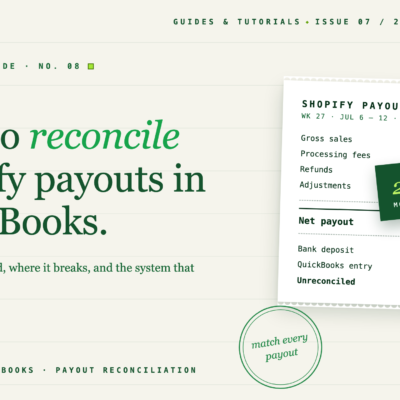
Continue Reading →: How to Reconcile Shopify Payouts in QuickBooks (The Real Method)The complete method for reconciling Shopify payouts in QuickBooks — the exact report to pull, the journal entry to build, where the manual process breaks, and what reconciliation looks like when it’s automated.
-
How to Sync WooCommerce with QuickBooks Online (And What Breaks)
Continue Reading →: How to Sync WooCommerce with QuickBooks Online (And What Breaks)Pushing WooCommerce orders into QuickBooks is the easy part. Matching them to the Stripe and PayPal deposits in your bank feed is where most integrations quietly fail.
-
Why Your Shopify Payout Never Matches What QuickBooks Shows
Continue Reading →: Why Your Shopify Payout Never Matches What QuickBooks ShowsBoth Shopify and QuickBooks are showing you correct numbers. So why do they never match? The answer is structural — and once you see it, the gap makes complete sense.
-
The Benefits of Automated Bookkeeping (For a Growing Shopify Store)
Continue Reading →: The Benefits of Automated Bookkeeping (For a Growing Shopify Store)The real benefits of automated bookkeeping for a Shopify store: quantified time savings, error reduction, and the one benefit nobody lists.
-
Chart of Accounts for E-commerce: How to Not Make Bad Mapping Decisions
Continue Reading →: Chart of Accounts for E-commerce: How to Not Make Bad Mapping DecisionsMost e-commerce chart of accounts templates fail at month-end because they’re built for gross revenue — not Shopify’s net payout structure. Here are the 5 mapping decisions that determine whether your books close in 30 minutes or 4 hours.




Automate Your E-commerce Accounting Today
Increase the value of every sale with automated bookkeeping that is hard to miss.
Try LedgerPort for Free