

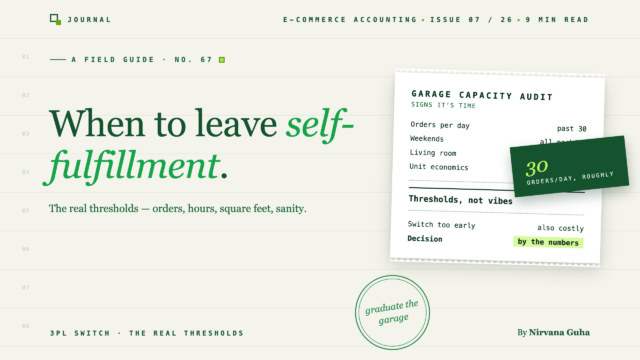
- 1The Lie: "There's a Magic Order Number"
- 2The Five Real Thresholds
- 31. The founder-time math
- 42. The space and lease forcing functions
- 53. The shipping-rate arbitrage
- 64. The service ceiling
- 75. Seasonality — the threshold that cuts both ways
- 8When to Switch to a 3PL: The Two-Signal Test
- 9Who Should NOT Switch Yet
- 10The Transition, Briefly
- 11You Came for a Number
The answer isn't an order count. It's five separate pressures — and the switch is right when two or three of them start pushing at once.
It's 11:40 on a Tuesday night and you're on order 41 of 63. The dining table has been a packing station since March. The label printer jammed twice, you're low on the medium mailers again, and tomorrow starts with a car full of packages and a line at the drop-off counter. Somewhere around order 50, you type the question into your phone: when to switch to a 3PL?
And the internet gives you a number. Five hundred orders a month, says one post. A hundred, says another. Ten a day. The numbers disagree with each other because none of them is the answer — they're placeholders for a decision that doesn't actually live in your order count.
You've probably done this dance before: looked it up, seen a threshold you hadn't hit yet, and gone back to the tape gun feeling like the decision was made for you. It wasn't. This post is the version of the answer that respects what's actually going on: five distinct forcing functions, each measurable from your own numbers this week, and an honest section on who shouldn't switch — because a 3PL is genuinely the wrong move for some stores, and the roundups rarely say so.
The Lie: "There's a Magic Order Number"
The belief that keeps founders packing at midnight is this: the switch point is a volume threshold, and until I hit it, self-fulfillment is the responsible choice.
It's an appealing lie because it's tidy. One number, one finish line, no judgment call. But it fails for a mechanical reason: two stores at the identical 600 orders a month can sit on opposite sides of the decision. One ships a single lightweight SKU from a garage with room to spare, packs an order in ninety seconds, and has a partner who handles mornings. The other ships forty SKUs in four box sizes from a one-bedroom apartment, spends fifteen hours a week on fulfillment, and just got a lease renewal notice. Same order count. Completely different answers.
Order volume is an input to the decision. It isn't the decision. The decision lives at the intersection of five pressures — and you can measure every one of them today.
The Five Real Thresholds
1. The founder-time math
Start with an honest count: how many hours a week does fulfillment actually take? Not just packing — receiving inventory, breaking down boxes, supply runs, printing labels, the daily carrier trip, the "where's my order" emails that exist because you shipped a day late.
Then price the hour. Not at what a packer earns — at what your hour is supposed to produce. If you're the person who does product development, marketing, and wholesale outreach, your hour is the most expensive labor in the company, and fulfillment is consuming it at packer rates.
A worked example with round, fictional numbers: 800 orders a month at roughly three minutes of total handling each is about 40 hours — plus call it 20 more for receiving, supplies, and carrier runs. That's 60 hours a month, nearly a third of a working life. If a founder-hour redirected to growth work is conservatively worth $75, that's $4,500 a month of foregone output — before you compare it to a fulfillment quote. When the honest version of this math produces a number bigger than the 3PL bill would be, the "savings" of self-fulfillment are already gone. This is the same time-times-frequency trap as doing your bookkeeping by CSV export: the manual path looks free because nobody invoices you for your own evenings.
2. The space and lease forcing functions
Sometimes the decision gets made by physics. The garage is full. You're renting a second storage unit and driving between them. Your next inventory buy doesn't fit anywhere you currently control.
Watch for the calendar versions too: a lease renewal that would mean signing another year of warehouse-shaped rent, a landlord asking questions about the box truck, an insurance policy that doesn't love commercial inventory in a residential space. These are natural decision points — a forced move is the single most common trigger for going to a 3PL, because the alternative is signing a lease that commits you to self-fulfillment for another term whether it still makes sense or not.
If a space decision is less than six months away, run the 3PL evaluation now, before the lease makes it for you.
3. The shipping-rate arbitrage
Here's the threshold almost nobody checks, and it occasionally makes the whole decision on its own: a 3PL may ship your packages for meaningfully less than you can.
The mechanism: 3PLs buy postage at deep commercial discounts earned by their volume across all clients, then resell it to you at a markup that's still usually below your retail or platform rate. Because postage is often half or more of a fulfillment bill, the gap between your current label cost and a 3PL's rate card can offset a real share of their pick, pack, and storage fees. For some stores — heavier products, longer average zones — the switch partially or entirely pays for itself on shipping alone.
The test is cheap: pull your five most common package profiles (weight, dimensions, typical destination zones) and your actual average label cost, then ask two or three candidate 3PLs to quote those exact profiles. We've broken down how those quotes are structured — and where the other fees hide — in how 3PL pricing actually works. Read that before the sales calls; it changes what you ask. And when a quote turns into a draft agreement, run it against the 3PL contract red flags before you sign.
4. The service ceiling
At some point the constraint isn't cost — it's what self-fulfillment can't deliver no matter how hard you work.
Customers increasingly expect two-day-ish delivery, and from a single location you can only offer that to your nearest zones. A 3PL with distributed inventory shortens zones structurally. Same with cutoff times: an order placed at 2 p.m. ships same-day from a staffed warehouse and tomorrow (maybe) from your kitchen. Returns are the quiet one — at a few percent of orders, processing returns is an annoyance; at apparel-level return rates it becomes a second fulfillment operation running in reverse.
And there's the single-point-of-failure problem, which is you. When you're sick, traveling, or at a trade show, shipping stops. A business where fulfillment pauses for the flu has a ceiling on how big it can safely get.
5. Seasonality — the threshold that cuts both ways
If Q4 is three times your normal volume, self-fulfillment means your worst weeks land exactly when the stakes are highest: more orders, tighter carrier deadlines, no slack. A 3PL absorbs peak with staffed shifts and (priced) surcharges — that elasticity is much of what you're paying for.
But seasonality argues the other direction too, and honest guides should say so. A 3PL bills storage and minimums in February just like November. If your volume is deeply seasonal, you'll pay for warehouse capacity in months you barely use it. Highly seasonal stores sometimes do better with a hybrid: self-fulfill the quiet months, or negotiate seasonal terms explicitly before signing.
When to Switch to a 3PL: The Two-Signal Test
Put the five together and the decision stops being mystical:
| Signal | The question to ask this week |
|---|---|
| Founder time | Is fulfillment consuming 10+ hours/week of your most expensive labor? |
| Space | Is a lease, storage, or space decision forcing your hand within ~6 months? |
| Shipping rates | Did a quoted rate card beat your current label costs on your real package profiles? |
| Service ceiling | Are delivery speed, cutoffs, or returns volume costing you sales or sanity? |
| Seasonality | Does peak volume break your process — and would off-peak minimums still be tolerable? |
Zero or one "yes": keep self-fulfilling and re-run the test each quarter. Two: start collecting quotes — the evaluation costs nothing and takes the guesswork out of the next check-in. Three or more: you're past the threshold, and every month of delay is paid for in founder-hours and missed cutoffs.
Who Should NOT Switch Yet
The counter-list matters as much as the thresholds, because a 3PL is a real downgrade for some stores:
- Fragile, personalized, or made-to-order products. If every order is engraved, monogrammed, assembled to spec, or breakable in ways that need practiced hands, a general-purpose warehouse will do it worse than you do. Customization work either stays in-house or gets billed as expensive special projects.
- Brand experiences built on the unboxing. Hand-written notes, elaborate tissue-and-ribbon presentation, kitting that changes weekly — 3PLs can do custom packaging, but it's billed per touch, and the more your packaging is marketing, the more the outsourced version costs or disappoints. Some brands correctly decide the box is the product and keep it.
- Sub-threshold volume. Below roughly a few hundred orders a month, monthly minimums and account fees do real damage: a minimum you don't reach turns a per-order price into a much higher effective rate. If a candidate's minimum is bigger than your natural bill, you're too early for that candidate — and possibly for the category.
- Cash-tight months. Switching front-loads cost: receiving fees on your entire inventory, first storage invoices, possibly deposits, all while you're still paying for your current setup during the overlap. If cash is tight, the switch's payback may be real but you have to survive the transition to collect it.
None of these is permanent. They're reasons to wait, redesign the packaging tier, or shortlist differently — a small-store-friendly regional 3PL instead of a national network, for instance. Our guide to the best 3PLs for Shopify stores by profile sorts candidates exactly that way.
The Transition, Briefly
Once the test says go, the switch itself is a six-to-eight-week project, not a weekend:
- Shortlist and quote two or three providers matched to your profile, using your real order data and package dimensions.
- Fix your SKU hygiene first. Every unit needs a scannable barcode that matches your catalog exactly. Mislabeled inventory is the number-one cause of expensive receiving and early mispicks — clean it up before the truck leaves.
- Wire up inventory sync between your store and the 3PL's system, and decide who's the source of truth for stock counts before day one, not after the first oversell.
- Run a parallel month. Send part of your inventory, route a portion of orders through the 3PL while you keep fulfilling the rest, and watch their accuracy, speed, and first invoice with your own process as the safety net. Cut over fully only when the month looks right.
One thing changes permanently on cutover day: fulfillment stops being your evenings and becomes a monthly invoice — a long, line-itemed one that deserves the same scrutiny your time used to get, which is why auditing your 3PL invoice is worth setting up in month one.
You Came for a Number
You searched for a threshold and the honest answer turned out to be a test: five pressures, measured from your own week, decided on intersection rather than any single line. That's better than a magic number — a number would have told every store the same thing, and the whole point is that your store isn't every store.
So run it: count the hours, check the calendar on your space, get two rate cards quoted against your real packages, and score yourself on the table above. If you land on "not yet," you've bought yourself a guilt-free quarter at the tape gun. If you land on "switch," the pricing and provider guides above are your next two reads — and once the invoices start arriving, our complete guide to e-commerce accounting covers where all of it lands in your books.