

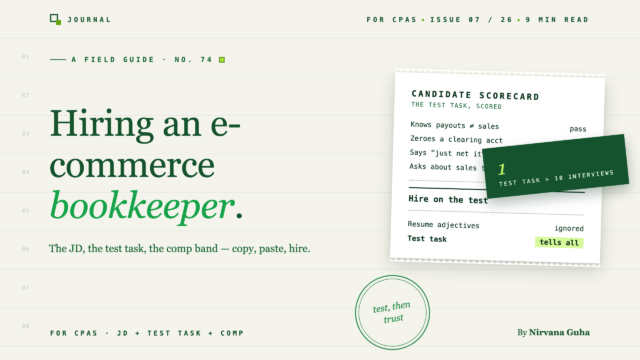
The resume says ten years of QuickBooks. The test task says they'd book your gift card sales as revenue. Only one of those predicts your next twelve months.
The references were excellent. Ten years of QuickBooks Online, a bookkeeping certificate, two glowing former employers — one of them a CPA. You hired them in March. In June you opened the file and found bank deposits booked straight to sales, a refunds account with nothing in it, and a clearing balance that had been growing since week two.
They weren't lying on the resume. They were genuinely good at bookkeeping — for the businesses they'd done it for. None of those businesses got paid in net disbursements that bundle sales, refunds, fees, and sales tax into a single bank line.
Most people hiring an ecommerce bookkeeper operate on the same assumption: a good bookkeeper is a good bookkeeper — QuickBooks is QuickBooks, and they'll pick up the Shopify part on the job. That's the lie, and it's an expensive one, because the failure doesn't show up in the interview. It shows up three months later, in a file that now needs a cleanup engagement.
Here's the truth: e-commerce bookkeeping is generic bookkeeping plus a specific, learnable delta of four competencies — and every one of them is testable in the hiring process, before the candidate ever touches your books. This post gives you the competency model, a copy-paste job description, a test task with explicit pass criteria, and a sane way to frame comp.
One note on who this is for. Firm owners hiring for an e-commerce client team and store owners hiring their first in-house bookkeeper need mostly the same process. Where the advice genuinely differs — and it does in a few places — this post says so explicitly rather than averaging the two into mush.
The Competency Model: Generic Skills Plus the E-commerce Delta
The generic layer is what every competent bookkeeper already has: double-entry fundamentals, bank feeds and reconciliation, chart of accounts hygiene, month-end discipline, and enough communication skill to flag what they don't understand instead of guessing. Screen for this the way you always have — references and history are decent predictors here.
The delta is what history won't tell you. Four competencies:
1. Payout reconciliation. They must understand that a platform payout is not revenue — it's a net disbursement containing gross sales, refunds, fees, adjustments, and sometimes sales tax, and each component posts to a different account through a clearing account that must zero. A bookkeeper who matches the bank deposit to "Sales" and moves on will quietly corrupt the file every single payout cycle.
2. Fee separation. Platform and processing fees have to surface as an expense, not vanish inside net revenue. A store doing $1M a year has $25,000–$30,000 in processing fees; booking net deposits as sales makes both the revenue and the expense fiction, and margins fiction with them.
3. Sales tax as a liability. Tax collected from customers is money held for a state, not income. It accrues to a liability account and draws down at remittance. Bookkeepers from service-business backgrounds get this wrong constantly, and it's the one defect on this list that carries audit exposure.
4. Platform report literacy. They need to navigate the platform's own finance reports — payout summaries, finance summaries, transaction exports — and treat them as the source of truth to reconcile the books against. A bookkeeper who only ever looks at QuickBooks can't catch what QuickBooks got wrong.
You don't need to hire someone who has all four already — the delta is learnable in weeks by anyone solid on the generic layer. What you need is a candidate who either has it or can demonstrably reason their way toward it. To sort candidates into those groups, hand them a two-item reading list before the interview: the e-commerce accounting pillar for the full conceptual model, and the payout reconciliation walkthrough for the mechanics of the hardest competency. Then interview against the material. Candidates who read it and can discuss why a clearing account must zero are trainable. Candidates who skimmed it and bluff are the March hire from the opening of this post.
The Job Description Skeleton
Copy, paste, and fill in the brackets. It's deliberately plain — the test task does the filtering, not the JD.
Title: E-commerce Bookkeeper ([full-time / part-time / contract])

About us: [2–3 sentences. Store owners: what you sell and rough order
volume. Firms: your e-commerce client count and the platforms they're on.]

The work:
- Own monthly bookkeeping in QuickBooks Online for [our store / a
  portfolio of e-commerce clients]
- Reconcile platform payouts (Shopify / WooCommerce / others) to bank
  deposits, with fees, refunds, and sales tax posted to the correct
  accounts
- Maintain a clearing account that zeros every payout cycle
- Run month-end close against a documented checklist and flag
  exceptions rather than forcing them to fit
- [Firms: work within our standardized chart of accounts and close
  process across clients]
- [Store owners: prepare a clean monthly package for our CPA]

You're a fit if:
- You have [X]+ years of bookkeeping experience in QuickBooks Online
- You either know e-commerce payout mechanics or can explain how you'd
  learn them (we'll ask — and there's a paid test task)
- You document what you do and ask before you guess

Process: short screen, a paid test task (2–3 hours), then a final
conversation. Comp: [range], [location/remote policy].
The line about the paid test task belongs in the JD itself. It repels the candidates who wanted to coast on references, and it signals to strong candidates that you evaluate work, not interviews.
The Test Task: One Fictional Messy Month
This is the part of the process that actually predicts performance, and it's the part almost nobody does. The design borrows its logic from the 15-minute file diagnostic that firms run on prospect files: e-commerce books break in a small number of known ways, so you test for exactly those breaks. The diagnostic detects the defects in an existing file; the test task checks whether a candidate would create them.
Build a one-page fictional scenario — clearly fake business, round numbers — and ask the candidate to describe (or record in a sandbox QuickBooks file, if you want to spend the setup time) how they'd book three things:
Item 1 — a payout to decompose. "Marigold Candle Co. received a bank deposit of $9,140 from Shopify. The payout report for that period shows $10,000 in gross sales, $600 in refunds, and $260 in processing fees." Ask: walk me through the entries, and tell me what the clearing account looks like when you're done.
A pass: gross sales to revenue, refunds to a contra-revenue account, fees to an expense account, and an explicit statement that the clearing account nets to zero against the $9,140 deposit. A fail: $9,140 to sales — the net-deposit defect, the single most common way e-commerce files rot.
Item 2 — a refund to book. "A customer returns a $120 order from last month. Shopify processes the refund; the processing fee from the original sale isn't returned." Ask: what do you book, and what do you not do?
A pass: refund to contra-revenue so gross sales, refunds, and net sales all stay visible, plus the observation that the unreturned fee stays in expenses. Bonus points if they mention checking how the refund flows through the next payout. A fail: netting it silently against sales — or the answer that should end the interview, deleting the transaction "because it doesn't match anything."
Item 3 — a gift card sale. "A customer buys a $200 gift card in December. In January, someone redeems $75 of it." Ask: when is this revenue?
A pass: the December sale is a liability — cash received for goods not yet delivered — and revenue is recognized at redemption, so $75 in January with $125 still on the liability. A fail: $200 of December revenue. This item is the sharpest generic-versus-delta separator of the three, because it's pure accounting reasoning; no platform knowledge required.
Score it simply: three passes is a hire-grade result, two passes with good reasoning on the miss is trainable, one or zero is a no — regardless of the references. Pay for the task (a flat $50–$100 honorarium is customary) and keep it under three hours out of respect for the candidate.
For firm owners, one addition: have the candidate write up their answers as if for a client-facing workpaper. You're testing documentation quality too, because their work will cross multiple files and other people will read it. Store owners can settle for a clear verbal walkthrough — but do the test anyway. You have less margin for a bad hire than a firm does, because there's no partner reviewing behind them. Whatever they book is what your CPA inherits at year-end.
Comp: Price the Role, Not the Resume
No salary table here, deliberately — bookkeeper comp varies enormously by market, seniority, and whether the role is employee, fractional, or offshore, and any number printed in a blog post is wrong in most cities it's read in.
The framing that holds up everywhere: price against your local market for the generic layer, then expect to pay a modest premium — or invest a few weeks of training — for the e-commerce delta. The delta is scarce enough to command something, but it's not so exotic that you should accept "e-commerce specialist" pricing without running the test task first. Plenty of premium-priced candidates fail item three.
The other lever is geography. Firm owners in particular should weigh the in-house hire against a distributed one — the trade-offs, management overhead, and where offshore genuinely works (and where it doesn't) are covered in the offshore staffing guide. The test task above works unchanged for offshore candidates, which is precisely the point: it evaluates the work, not the accent, the time zone, or the rate card.
Store owners doing under a few hundred orders a month usually don't need a full-time hire at all — a fractional bookkeeper at a few hours a month is the right size. Run the same test task. Fractional doesn't mean unvetted.
Onboarding: Put Them on Runsheets, Not Vibes
The hire succeeds or fails in the first three closes, and the difference is whether you hand them a documented process or a login and good wishes.
Give them a written close runsheet from day one — the month-end close checklist is built for exactly this, and it works for a single store as well as a client portfolio. Then run the three-close ramp: first close, they shadow you (or whoever closed last month) working the checklist. Second close, they drive and you review every line. Third close, they own it and you spot-check the two highest-risk items — the clearing account balance and the sales tax liability.
The runsheet does something subtler than quality control. It converts your e-commerce delta from tribal knowledge into a document, which means your next hire onboards in weeks instead of months — and for firm owners, it means the work is delegable to the least senior person who can follow it. That's the entire margin story of an e-commerce service line, compressed into a checklist.
The Hire That Makes June Boring
Run this process — reading list, JD, test task, runsheet ramp — and the June file review from the opening of this post becomes uneventful. Clearing at zero. Refunds visible in contra-revenue. Gift card liability drawing down on schedule. Not because you got lucky with a resume, but because you tested for the four competencies that resumes don't capture, then onboarded onto a process instead of a personality.
The candidates who pass the gift-card question exist. The test task is how you find them before March instead of after June.
Firm owners building out an e-commerce team: the hiring process above pairs with the tooling and workflow side of the practice — see how LedgerPort works with CPA and accounting firms.