

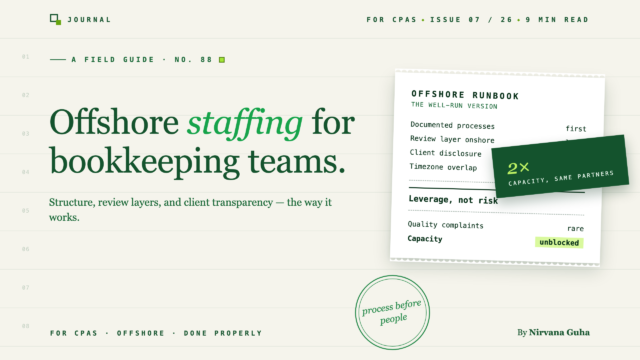
The firms that fail at offshore treat it as a discount. The firms that succeed treat it as a delegation problem — and they'd have failed with an onshore hire too.
You tried it eighteen months ago. An agency placed a bookkeeper in Manila — good English, QuickBooks certified, genuinely diligent. You handed her three client files and a login. By month two the clearing accounts were drifting, by month three a client asked why their refunds column looked strange, and by month four you'd quietly taken the work back. The postmortem at your firm was one sentence long: offshore doesn't work for e-commerce books.
That postmortem is the lie, and it's worth naming precisely because it feels so reasonable. Offshore bookkeeping staff didn't fail you. You handed a capable person three undocumented client files, no runsheet, no scoped access, no review cadence — and got exactly what an onshore hire would have produced under the same conditions, minus the hallway conversations that might have surfaced the drift sooner. Distance didn't cause the failure. Distance just removed the safety net that was hiding the absence of process.
Here's the truth this post is built on: offshore staffing succeeds or fails on two decisions that have nothing to do with geography — which model you hire through and what work you actually delegate. Get those right and the time zone becomes an asset instead of a liability. Get them wrong and no corridor on earth will save the engagement.
One thing this post won't do is quote wage numbers. Rates vary enormously by country, seniority, and model, and any figure printed here would be wrong in most of the corridors it's read in. The framing that holds up: price your corridor honestly. You are competing for good people in their labor market, and the firms that pay well within that market get the retention, the initiative, and the referrals. The firms that shop purely on rate get the churn they paid for.
The Three Models — Control, Cost, and Risk
There are three ways to put offshore capacity on your team, and most bad experiences trace back to picking the wrong one for the firm's stage — not to the people.
| Model | Control | Cost structure | Where the risk sits |
|---|---|---|---|
| Direct hire | Highest — your employee, your process, your culture | Salary + benefits + compliance overhead | On you: employment law, payroll, retention |
| Staffing agency / EOR | High on the work, shared on the employment | Per-seat monthly fee with the agency's margin built in | Split: agency handles employment; you still own training and review |
| Subcontracting to an offshore firm | Lowest — you buy outcomes, not people | Per-client or per-hour engagement pricing | On the vendor for delivery — but on you for quality, because your name is on the work |
Direct hire is where firms with five or more offshore seats usually end up, because the economics and loyalty are best — but it means running foreign payroll, employment compliance, and local benefits yourself, or engaging an employer-of-record to carry the employment while you carry the work. It's the right model when you have documented processes and enough volume to justify the administrative setup. It's the wrong first move.
Agencies and EOR arrangements are the sane starting point for most firms. You interview and select the person, the agency employs them, and you pay a bundled rate. You give up some margin and some retention control — good people inside agencies get recruited to other clients — but you get speed and a legal structure someone else maintains. Treat the agency seat like your own hire anyway: same onboarding, same runsheets, same review. The agency handles employment; it does not handle competence.
Subcontracting to an offshore bookkeeping firm — sending whole client files to a vendor who does the work under your review — is the fastest to start and the hardest to do well. You get capacity without hiring anyone, but you inherit the vendor's process instead of installing your own, staff turnover on your files is invisible to you, and quality varies with whoever the vendor assigned that month. It can work for overflow and cleanup projects. It's a fragile foundation for a recurring monthly close, because the thing that makes e-commerce books profitable — a standardized process you control — is exactly what you've outsourced.
Whichever model you choose, the selection bar doesn't move. The hiring guide for e-commerce bookkeepers has the competency model and a paid test task with pass criteria, and the test works unchanged for offshore candidates — that's the point of testing the work instead of the resume. This post won't repeat the JD or the test items; run them as written.
What Offshore Bookkeeping Staff Should Do — and Shouldn't
This is the decision that actually determines the outcome, and there's a clean rule for it: offshore work runs on runsheets; judgment stays with the reviewer.
E-commerce client books are unusually good offshore material, because the recurring work is procedural in a way general bookkeeping often isn't. What delegates well:
- The month-end close, worked as a checklist. The month-end close checklist for e-commerce clients exists precisely for this — five verification steps with explicit pass conditions, about thirty minutes per client. A pass condition is the offshore-enablement unit: "clearing account balance is zero" doesn't require a hallway conversation to verify. Your offshore staffer works the runsheet and flags exceptions; nobody improvises.
- Reconciliation review. Confirming payouts matched to bank deposits, checking that fees landed in the expense account and refunds in contra-revenue, verifying the sales tax liability moved the way the payout report says it should. The source data says what's true; the job is checking the books against it.
- Data hygiene. Uncategorized transactions, stale unmatched entries in the bank feed, mapping exceptions, missing vendor names, the unglamorous grooming that keeps a file review-ready. This work is important, procedural, and chronically deferred by senior staff — which makes it the single best first delegation.
What shouldn't go offshore — not because of skill, but because of structure:
- Client-facing advisory. The client hired your firm's judgment and your accent on the Zoom call. Advisory conversations, scope discussions, and "what does this number mean for my business" belong with whoever owns the relationship.
- Judgment calls. Is this deposit a gift card liability or revenue? Does this marketplace holdback need an adjusting entry? Anything whose honest answer starts with "it depends" is reviewer work. A runsheet can detect the anomaly; it can't decide what the anomaly means.
- Final review. The last set of eyes before the client sees the file is onshore, senior, and accountable — every close, every client, no exceptions. Call it the review-layer rule: offshore extends your capacity to produce the close; it never replaces the layer that signs off on it. The March disaster stories all share one plot point, and it's a skipped review, not a bad hire.
Notice what this rule implies about sequencing. If your close isn't already a documented checklist that a new onshore junior could work, you don't have an offshore opportunity yet — you have a documentation project. Which brings us to the prerequisite.
The Enablement Prerequisite: Processes and Scoped Access
Two things must exist before the first offshore staffer logs in. Neither is optional, and both pay for themselves even if you never hire offshore.
Documented processes. The standard to hit is the client onboarding template: five stages, explicit times, a checklist that marks the client live. That's what "documented" means — not a Notion page of good intentions, but a procedure specific enough that following it produces the same result regardless of who follows it. Every recurring task you intend to delegate needs a document at that grade: the close runsheet, the reconciliation review steps, the exception-escalation path ("when the clearing account doesn't zero, you stop and flag — you do not force it"). Writing these is the real cost of going offshore, and it's a cost you were already carrying invisibly as tribal knowledge.
Role-scoped tool access. Nobody — onshore or offshore — should work from a shared login, and nobody should hold more access than their runsheet requires. Least privilege is the whole principle. In QuickBooks Online Accountant, staff access is assignable per client. In your sync tooling, use the roles the tool gives you: LedgerPort's Admin/Member split, for instance, lets a staffer view sync logs, run manual syncs, and review mappings on a client's books without touching billing or sync configuration — the setup is in the team members and roles doc. The same logic applies to whatever else is in your stack.
Round it out with the boring hygiene that prevents the expensive stories: credentials issued through a password manager, never pasted into chat; multi-factor authentication on everything that touches client data; individual named accounts so the audit trail means something; and an offboarding checklist that revokes every credential the same day a departure is decided — agency churn makes this one non-negotiable. None of this is offshore-specific. Offshore just removes your ability to pretend the gaps don't exist.
The Client Disclosure Question
Do you tell clients that offshore staff touch their books? The practitioner answer: yes, in the engagement letter, in plain language — and here's why the transparent posture wins even where it isn't mandated.
Some jurisdictions and professional bodies have explicit requirements about disclosing or obtaining consent for outsourced work, particularly anything adjacent to tax return preparation. This post isn't going to enumerate them: confirm the requirements with your professional body before the first file moves. But compliance is the floor, not the reason. The reason is that a client who discovers undisclosed offshore staffing later doesn't hear "efficient delivery model" — they hear "hidden." One sentence in the engagement letter defuses it permanently: "The firm may use qualified staff located outside [country], operating under the firm's supervision, security controls, and review procedures, to perform bookkeeping services under this engagement." Say it once, say it early. Firms that run this posture find the clients who object are rare — and the ones who do were usually going to be difficult about something.
The disclosure is also easier to make when it's true. "Under the firm's supervision, security controls, and review procedures" is a claim you can only put in writing if the previous section actually exists.
The Time Zone Is a Feature
The objection everyone starts with — "they're twelve hours away" — is the thing mature offshore teams like best.
Run the overnight close pattern: your offshore staffer works the close runsheet during their day, which is your night. Exceptions get flagged in your project tool with the file state saved. You arrive in the morning to a close that's either done pending review or stopped at a precisely documented question. Review happens in your morning, their evening — which is also your overlap window, so keep a real one: 60–90 minutes of shared working hours for standups and questions, protected on both calendars. A fully asynchronous arrangement with no overlap is where small confusions compound into March disasters.
During the close week, this is the difference between a firm that closes clients serially and a firm whose files move overnight. The work literally happens while you sleep — not as a slogan, but as a scheduling fact.
What It Looks Like When It's Honest
Here's the tragicomic ending, because the honest version has trade-offs. The first ninety days cost more than they save: you'll write runsheets, run a paid test task, sit the overlap window daily, and review everything at 100% before you earn the right to spot-check. Churn is real, especially through agencies, and every departure restarts the ramp. Management attention is the actual currency — offshore staff don't reduce the need for management; they reduce the need for your hands on the keyboard.
And when it holds? The close runs overnight against a checklist. Data hygiene stops being deferred. Your senior people spend their hours on review and advisory — the layers that price a premium — instead of matching deposits. The failed experiment from eighteen months ago turns out to have been a missing-runsheet problem wearing a geography costume.
The prerequisite work — documented close, scoped access, review layer — is the same work that makes the e-commerce service line profitable with any staffing model. Start there, and the offshore decision gets easy.
Firm owners building the delegation infrastructure first: the tooling side — client isolation, role-scoped team access, sync logs your reviewers can audit — is what LedgerPort for CPA and accounting firms is built around.