

- 1The Money Moves Before the Sale Does
- 2The Fee Tsunami: Your Blended Rate Shifts With the Cart
- 3Set Up Discount Accounting Before the Volume Hits
- 4The Volume Stress Test: Will Your Method Survive a 10x Day?
- 5Payout Lag: Bigger Sales Mean a Bigger Exposure Window
- 6The January Returns Shadow
- 7The BFCM Finance Preparation Checklist
- 8The Weekend Is Won in October
Ads, inventory, and site speed all have a checklist. Your books don't — and they're the part that decides whether the weekend was actually profitable.
Think back to your last Black Friday. The dashboard was a fireworks show — best weekend of the year, maybe double a normal month in four days. Then December arrived and the glow faded fast: the bank balance was lower than the sales numbers implied, the credit card bill for October's inventory order came due, and QuickBooks was so far behind that you didn't actually know what the weekend made you until February.
You had a BFCM preparation checklist last year. Everyone does — ad budgets, inventory counts, site load tests, email calendars. What almost nobody has is a BFCM preparation checklist for finance, because the entire content industry writes the ops-and-marketing version and stops there.
The lie underneath that gap is comfortable: "BFCM prep is an ops and marketing project — the books can catch up in December." The truth is less comfortable and more useful. BFCM is a cash-timing and accounting-load event, and the finance side is decided in September and October, before the first discount goes live. Here's the checklist nobody writes.
The Money Moves Before the Sale Does
The defining finance fact of BFCM: you pay for it months before it pays you. Holiday inventory POs get placed around late summer and paid on whatever terms you negotiated — often before a single unit sells. The revenue arrives in late November, and the cash arrives days later than that, after payout lag (more on that below).
That's a two-to-three-month trench where cash goes out in five figures and comes back as zero. Stores don't get in trouble during BFCM — they get in trouble in October, when the PO payment, the ad-spend ramp, and normal operating costs all stack on top of ordinary revenue.
Two tools handle this. A 13-week cash flow forecast makes the trench visible week by week, so you know before you commit whether you can cover the gap or need a line of credit arranged in advance. And inventory forecasting sizes the PO itself — the single biggest cash decision of your year — against demand instead of optimism.
If you do nothing else from this post: build the 13-week forecast in September, with the PO payment dates and the expected payout dates on it. Most BFCM cash surprises are visible eight weeks out, on one page.
The Fee Tsunami: Your Blended Rate Shifts With the Cart
Here's the line item that quietly reprices your whole weekend: payment fees. Holiday carts are bigger, more gift-driven, and far more likely to check out with buy-now-pay-later. Shop Pay Installments, Klarna, and Afterpay all cost meaningfully more per order than a standard card swipe — so as BNPL share climbs during the promotion, your blended fee rate climbs with it.
A store that normally runs ~3% in processing costs can come out of a BNPL-heavy weekend closer to 4% — on the highest-volume days of the year, at discounted margins. If you modeled your BFCM profitability using your normal fee rate, your model is wrong in the expensive direction.
The prep is simple: know your blended rate today, before the season. Pull a normal month, divide total processing fees by gross sales, and write the number down. Then make sure the fees are visible enough to recompute in December — Shopify's fees hide in more places than one, and third-party BNPL fees don't appear in your Shopify payout report at all. A fee you can't see is a fee you can't price against.
Set Up Discount Accounting Before the Volume Hits
BFCM is a discount event, so get the discount accounting right while order volume is still low enough to fix mistakes. Two rules matter.
First: discounts are contra-revenue, not expenses and not silence. A $100 order sold at 30% off should post as $100 of gross sales and $30 in a Discounts contra-revenue account — not as a bare $70 sale. Do it the bare way and your January reports can't tell you what the promotion actually cost, which is the one question BFCM analysis has to answer. Create the contra-revenue account now and confirm whatever posts your sales actually uses it.
Second: gift cards sold in a promotion are not revenue. They're a liability — money you owe back in merchandise, sitting on the balance sheet until redemption. A "$50 gift card for $40" holiday promo touches revenue only when the card is spent, mostly in January. Book gift card sales as income during BFCM and you'll overstate your best month and understate the next one — the full liability-to-redemption lifecycle is here, and the account it needs takes five minutes to create in October.
The Volume Stress Test: Will Your Method Survive a 10x Day?
Whatever gets your Shopify sales into QuickBooks — manual entries, CSV imports, per-order sync — was chosen at normal volume. BFCM is the day that choice gets audited. A store doing 60 orders a day might do 600 or more on peak days. If your method is per-order, that's a flood of individual transactions hitting QuickBooks in a weekend; if it's manual, that's a data-entry backlog you'll still be clearing in the new year.
The daily-summary approach is built for exactly this: one journal entry per day — gross sales, discounts, gift cards, fees, refunds — that stays one entry per day whether you sold 60 orders or 6,000. If you're going to switch methods, switch in October and run it for a few normal weeks first. Peak weekend is the worst possible time to debug a new bookkeeping system.
This is also where automation earns its keep, frankly. A sync tool that posts structured daily summaries doesn't care about volume — LedgerPort's order sync methods work the same on a 10x day as a normal one, and if you set it up mid-season it can backfill the historical orders you already took. But manual or automated, run the stress test on paper now: "if we 10x for four days, what breaks?"
Payout Lag: Bigger Sales Mean a Bigger Exposure Window
Your processor doesn't hand you Saturday's sales on Saturday. Standard payout schedules run days behind, and the gap between "sold" and "settled" is money sitting with the processor — your exposure window. At normal volume it's a rounding error. During BFCM it can be the biggest receivable your business has, right when your bills are peaking.
Three things to check in October. Know your actual payout schedule and how weekends and bank holidays shift it — a late-November weekend spike can land as cash days later than you'd guess. Know whether your processor applies rolling reserves or holds on unusual volume spikes; a sudden 10x weekend is precisely the pattern risk systems flag. And put the expected payout dates on the 13-week forecast from earlier, so the trench between peak sales and peak cash is planned, not discovered.
The January Returns Shadow
Every BFCM casts a shadow, and it arrives in January: elevated returns on holiday volume. Some of what you're celebrating in November will come back — and if your books treat December's number as final, January's refund wave reads as a mysterious collapse instead of a predictable echo.
The fix is reserve thinking. Pull last year's post-holiday return rate (or use your normal rate plus a holiday cushion), and treat that slice of BFCM revenue as provisional — earmarked, not spent. Accrual-basis stores can discuss a formal returns reserve with their CPA; cash-basis stores can at least hold the mental reserve and the cash. Either way, refunds have their own accounting mechanics — processing fees usually aren't returned to you, which makes every refund slightly worse than a reversed sale — and the full January returns survival guide covers the wave itself when you're in it.
The prep step is one number: estimated return dollars on projected BFCM sales. Write it next to your revenue goal.
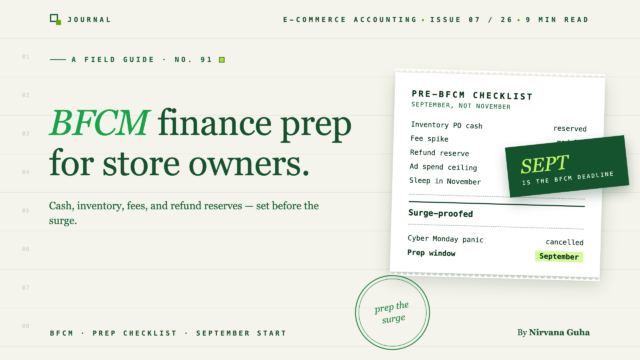
The BFCM Finance Preparation Checklist
Everything above, condensed to the list to run before the season:
- Books reconciled through September. Enter the storm current, not behind — payouts matched to deposits, no mystery balances. Cleanup is a low-volume-month job; December will not offer you one.
- 13-week cash forecast built, with PO payment dates, ad-spend ramp, and expected payout dates on it.
- Blended fee rate baseline recorded, and BNPL fees visible somewhere you can actually read them.
- Discounts contra-revenue account created and confirmed in use.
- Gift card liability account created if any promo involves gift cards.
- Recording method stress-tested against a 10x day — switched and settled by October if switching.
- Payout schedule and hold policy confirmed with your processor.
- Returns reserve estimated and written next to the revenue goal.
Eight boxes. None require a big budget; all require doing them before the volume hits, which is the entire trick.
The Weekend Is Won in October
Picture the other version of December: the payouts land on the dates your forecast predicted, the fee line shows exactly what BNPL cost you, the discounts sit on their own report line, and the books are current enough that you know the weekend's real margin while it still matters. Same sales. Different business.
That's what the finance side of BFCM prep buys — not more revenue, but the ability to know what the revenue was worth. If the item you're least confident about is the books themselves — reconciled through September, structured to survive a 10x day — that's the category LedgerPort automates: sales, discounts, fees, and refunds posted to QuickBooks in the same clean structure at any volume. The free plan is a low-risk way to run your stress test before the season starts →